
A Pharmacological Rationale for Protecting the Equine Lamellar Interface
Investigational — not an approved medicine. PTP-102 is an investigational veterinary development candidate. Nothing on this page constitutes regulatory approval, a claim of clinical efficacy, or prescribing information.
Scientific overview
PTP-102 is a methylated tirilazad development candidate within the 21-aminosteroid, or lazaroid, pharmacological class. Lazaroids were developed as non-glucocorticoid inhibitors of oxidative membrane injury, with a substantial experimental literature describing inhibition of membrane lipid peroxidation, reactive-radical chemistry and secondary cellular injury.
The current veterinary programme asks a different translational question from the historical human neuroprotection programmes: whether this pharmacology has relevance in the acutely injured equine lamella, where inflammatory signalling, metabolic disruption, extracellular-matrix remodelling and structural failure converge at the dermal–epidermal interface.
A peer-reviewed 2024 equine study provides an important experimental bridge. In an oligofructose-induced laminitis model, 20 horses were randomized across control, untreated laminitis, prophylactic methylated-tirilazad and post-onset treatment groups. The investigators reported improvement across selected clinical, inflammatory and lamellar-tissue endpoints following methylated tirilazad intervention, with the treatment group performing more strongly than the prophylactic group on several measures. These findings are hypothesis-supporting rather than definitive and require confirmation in broader, prospectively designed clinical development.
21-Aminosteroid Pharmacology
Membrane lipid-peroxidation inhibition and radical-scavenging pharmacology are established features of the tirilazad/lazaroid literature.
Published Equine Signal
A 2024 peer-reviewed experimental study evaluated methylated tirilazad in an oligofructose-induced equine laminitis model.
Translational Development
The current programme moves from mechanistic rationale and experimental evidence toward formulation, safety, clinical evaluation and veterinary regulatory development.
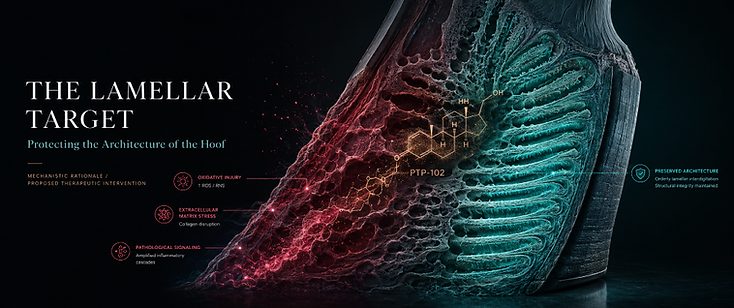
The Lamellar Target
Why preservation of the dermal–epidermal interface matters
Laminitis is not a single-pathway disease. It is a clinical syndrome in which systemic or local disease processes converge on the suspensory apparatus of the distal phalanx. Modern pathology has moved beyond the older idea that laminitis is simply a primary basement-membrane dissolution disorder. The contemporary view includes early lamellar-cell stretching, cytoskeletal and adhesion abnormalities, inflammatory and metabolic signalling, microvascular disturbance and extracellular-matrix remodelling, with the dominant initiating biology varying between sepsis-associated, endocrinopathic and supporting-limb disease.
For an acute investigational programme, the relevant therapeutic concept is therefore not “repairing a hoof” after structural collapse. It is whether secondary biochemical injury can be attenuated during the interval in which lamellar architecture is becoming unstable.
Matrix metalloproteinases remain one mechanistically relevant component of this biology. Increased MMP-2 transcription has been demonstrated during developmental laminitis, and MMP-14 has been implicated in acute-phase onset. However, MMP activity should not be presented as the sole cause of lamellar failure. It sits within a broader network of epithelial adhesion, inflammatory cell recruitment, oxidative stress, tissue metabolism and extracellular-matrix turnover.
The 2024 methylated-tirilazad study is directly relevant because the investigators did not rely only on lameness scoring. Their experimental design included gross hoof examination, histopathology, inflammatory indices, MMP-related measurements and microbiome analysis. Oligofructose challenge produced haemorrhage, swelling and marked lamellar structural injury. Following methylated tirilazad treatment, the investigators reported lamellar morphology that was more similar to control tissue and improvement in several clinical and laboratory measures. The authors appropriately concluded that the underlying mechanism requires further investigation.
This distinction is important for the PTP-102 programme. The present mechanistic proposition is preservation of vulnerable lamellar architecture during acute biochemical injury, not a claim that established mechanical displacement or chronic hoof deformation has been clinically reversed.
What a veterinarian should take from this
The biological target is the lamellar interface before irreversible structural failure. PTP-102 is being investigated as a pharmacological intervention within that acute injury window; it should not be represented as a mechanical correction for chronic rotation, distal displacement or established hoof-capsule pathology.

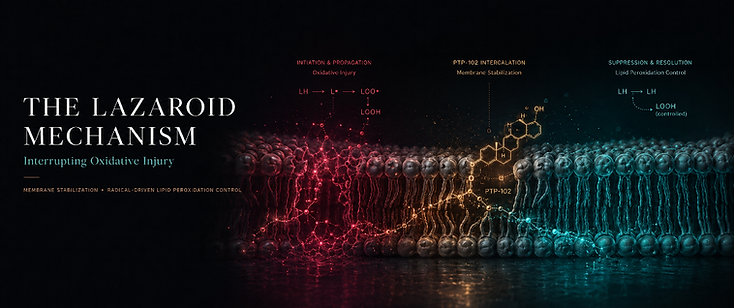
The Lazaroid Mechanism
Interrupting oxidative injury at the membrane
Tirilazad belongs to the 21-aminosteroid class developed specifically to retain potent antioxidant and membrane-protective actions without conventional glucocorticoid activity. The historical lazaroid literature repeatedly characterises tirilazad as an inhibitor of oxygen-radical-driven membrane lipid peroxidation and as a radical-scavenging cytoprotective compound.
That pharmacology is best understood as a chain-interruption problem.
Polyunsaturated membrane lipids are vulnerable to radical attack. Once a lipid radical is generated, reaction with molecular oxygen can produce lipid-peroxyl species capable of propagating further membrane oxidation. The result is not simply the presence of “free radicals”; it is an amplifying alteration of membrane lipids, membrane-associated proteins, permeability, ion handling and intracellular signalling.
Lazaroid pharmacology was developed around this lipophilic environment. Experimental work describes tirilazad as associating with biological membranes, reducing membrane fluidity and limiting propagation of lipid-peroxidation reactions. Other studies demonstrate attenuation of reactive-oxygen-species formation, preservation of membrane phospholipids and delay of irreversible cellular injury during energetic stress.
For PTP-102, this produces a coherent mechanistic rationale: a lipophilic 21-aminosteroid scaffold positioned within the membrane environment may be pharmacologically relevant where oxidative membrane injury forms part of a larger inflammatory and tissue-destructive cascade. The most defensible model for this programme is membrane localisation, radical-chain interruption and suppression of lipid peroxidation.
Initiation
Reactive oxygen chemistry initiates lipid-radical formation within a vulnerable membrane environment.
Propagation
Lipid-peroxyl species can perpetuate oxidative damage across adjacent membrane lipids and membrane-associated systems.
Interruption
The lazaroid pharmacological model is consistent with membrane association, radical scavenging and inhibition of lipid-peroxidation propagation.
Why membrane pharmacology may matter in laminitis
The lamellar interface is a highly specialised, mechanically loaded epithelial–connective-tissue junction. Cellular injury that destabilises membrane function, adhesion signalling, energy balance or matrix regulation may be amplified rapidly when the tissue remains under load. A membrane-directed antioxidant strategy is therefore biologically distinct from non-specific systemic anti-inflammatory therapy.

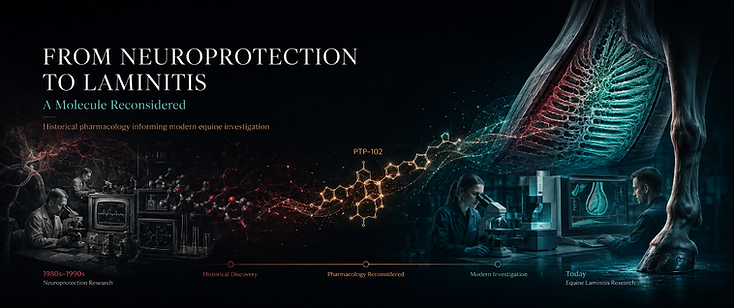
From Neuroprotection to Laminitis
A pharmacological class reconsidered
Tirilazad entered clinical development because lipid peroxidation and secondary oxidative injury were considered tractable components of acute central nervous system injury. The compound was studied extensively in experimental cerebral ischaemia, traumatic injury, subarachnoid haemorrhage and spinal cord injury before moving into large human clinical programmes.
The subsequent clinical record is important precisely because it is mixed.
In a large Europe/Australia/New Zealand aneurysmal subarachnoid haemorrhage trial, the 6 mg/kg/day dose was associated with improved overall outcome, with much of the apparent benefit occurring in men. A similarly large North American trial did not reproduce an overall improvement in mortality or favourable outcome. A later meta-analysis of five randomized SAH trials comprising 3,797 patients found no significant overall reduction in unfavourable clinical outcome or cerebral infarction.
The acute ischaemic-stroke programme was less encouraging. A systematic review identified six placebo-controlled trials involving 1,757 patients and found no mortality benefit; disability outcomes were worse overall in the tirilazad groups. Those data appropriately ended the rationale for further human ischaemic-stroke trials.
In acute spinal cord injury, tirilazad was evaluated in NASCIS III alongside methylprednisolone regimens. That programme contributed further human exposure and pharmacological characterisation, but did not establish tirilazad as a replacement standard of care.
For a translational programme, these results should not be hidden and they should not be oversimplified. They demonstrate a familiar drug-development problem: strong mechanism and experimental biology do not guarantee efficacy in a heterogeneous human syndrome with difficult treatment timing, exposure, sex-related pharmacokinetic differences, interacting therapies and complex endpoints.
That history is scientifically useful to PTP-102. It provides a deeply characterised pharmacological starting point, substantial prior systemic exposure, known pharmacokinetic behaviour and documented drug–drug interaction signals. It also places a high evidentiary burden on the veterinary programme: equine efficacy must be demonstrated in the target disease, at the target dose, with clinically meaningful endpoints. Historical human neuroprotection is a source of pharmacological knowledge — not a surrogate for equine efficacy.
Experimental neuroprotection
Strong preclinical signal across multiple oxidative and ischaemic injury models.
Aneurysmal SAH
Large trials produced heterogeneous results; pooled evidence did not establish an overall outcome benefit.
Acute ischaemic stroke
Systematic review did not support efficacy and reported worse disability outcomes overall.
Translational lesson
Mechanism, exposure, timing, target pathology and endpoint selection must align in the target species and indication.
A useful historical safety / PK signal
Tirilazad undergoes hepatic metabolism. In healthy volunteers, concomitant phenytoin markedly induced tirilazad metabolism and increased clearance, demonstrating that exposure can be sensitive to enzyme-inducing co-medication. This historical interaction is relevant when constructing modern veterinary exclusion criteria, concomitant-medication rules and PK interpretation.

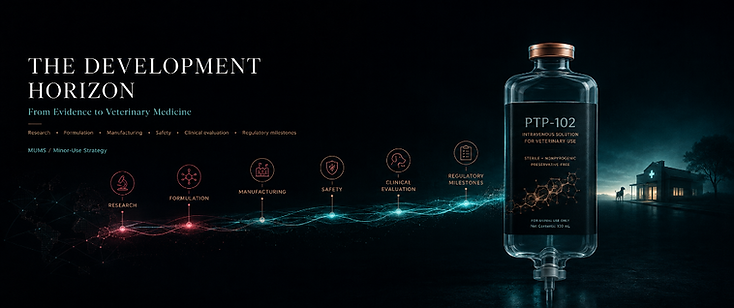
The Development Horizon
From experimental evidence to a veterinary development programme
The next stage of the PTP-102 story is not a marketing transition; it is an evidence transition.
A veterinary medicinal product must connect identity, formulation, manufacturing control, target-animal safety, pharmacology, dose selection and clinically meaningful effectiveness into a coherent development package. For an intravenous candidate intended for acute equine disease, these workstreams are tightly coupled. Formulation governs exposure and administration practicality. Manufacturing controls govern reproducibility. Dose and infusion conditions influence safety margins. Case definition and timing determine whether an efficacy study is testing the intended biological window.
The current scientific rationale is strongest when the programme is presented as a sequence of questions rather than a sequence of presumed successes: whether the active pharmaceutical ingredient and formulation can be reproducibly characterised; whether the intended intravenous exposure is tolerated in the target species; what dose and treatment window are biologically justified; whether structural and clinical endpoints tell the same story; and whether the evidence can support the intended regulatory pathway.
The published 2024 equine study provides a proof-of-concept signal, including administration after clinical onset and a second dose 12 hours later. A development programme should independently establish dose rationale, exposure, repeat-dose logic and the relationship between treatment timing and clinically meaningful response.
Research
Mechanistic rationale and published experimental evidence define the biological question.
Minor-use strategy in a major species
FDA classifies horses as a major species. A proposed laminitis indication can enter the MUMS framework only if the intended use meets FDA's minor-use criteria. Conditional approval, where applicable, still requires the sponsor to meet the applicable safety and manufacturing standards and to establish a reasonable expectation of effectiveness while completing the effectiveness evidence required for full approval. PTP-102 is described here as an investigational veterinary development programme; no approval status is claimed.
Programme documents are held under controlled access
Formulation, manufacturing, target-animal safety, protocol and regulatory-correspondence documents are not published on this page. They are released only to verified counterparties under executed confidentiality terms through the licensing deal room, or to approved investigators through the clinical trial portal. Any formulation, dose, container, storage or route information must come from the current controlled programme documents — not from the conceptual artwork on this page.
Selected Scientific Evidence
The PTP-102 programme sits at the intersection of three evidence domains: contemporary equine laminitis biology, published methylated-tirilazad data in horses, and the historical pharmacology and clinical development of tirilazad / 21-aminosteroids.
Methylated tirilazad may mitigate oligofructose-induced laminitis in horses
Tuniyazi M, Tang R, Hu X, Zhang N · Frontiers in Microbiology · 2024
Published experimental equine study reporting improvement across selected clinical, inflammatory and lamellar-tissue endpoints following methylated tirilazad intervention.
Paradigm shifts in understanding equine laminitis
Patterson-Kane JC, Karikoski NP, McGowan CM · The Veterinary Journal · 2018
Contemporary review moving beyond basement-membrane dissolution as a single explanatory model of lamellar failure.
Equine laminitis: increased transcription of matrix metalloproteinase-2 occurs during the developmental phase
Kyaw-Tanner M, Pollitt CC · Equine Veterinary Journal · 2004
Demonstrates increased MMP-2 transcription during developmental laminitis.
Equine laminitis: membrane type matrix metalloproteinase-1 (MMP-14) is involved in acute phase onset
Kyaw-Tanner MT, Wattle O, van Eps AW, Pollitt CC · Equine Veterinary Journal · 2008
Implicates MMP-14 in acute-phase onset of lamellar injury.
Tirilazad mesylate (Freedox) — an effective inhibitor of lipid membrane peroxidation
PubMed PMID 9333426 · PubMed · 1997
Characterises tirilazad as an inhibitor of membrane lipid peroxidation.
The mechanism of cytoprotective action of lazaroids I: inhibition of reactive oxygen species formation and lethal cell injury during periods of energy depletion
Hall ED et al. · PubMed · 1996
Describes attenuation of reactive-oxygen-species formation and delay of irreversible cellular injury.
The effects of glucocorticoid and nonglucocorticoid steroids on acute neuronal degeneration
Hall ED et al. · PubMed · 1993
Distinguishes non-glucocorticoid 21-aminosteroid pharmacology from conventional steroid activity.
Protective effect of the 21-aminosteroid lipid peroxidation inhibitor tirilazad mesylate on hepatic endothelium in experimental hemorrhagic shock
Eversole RR et al. · PubMed · 1993
Experimental evidence of membrane-protective action outside the central nervous system.
Randomized, double-blind, vehicle-controlled trial of tirilazad mesylate in aneurysmal subarachnoid hemorrhage: Europe, Australia and New Zealand
Kassell NF et al. · Journal of Neurosurgery · 1996
Reported improved overall outcome at 6 mg/kg/day, with much of the apparent benefit occurring in men.
Randomized, double-blind, vehicle-controlled trial of tirilazad mesylate in aneurysmal subarachnoid hemorrhage: North America
Haley EC Jr et al. · Journal of Neurosurgery · 1997
Did not reproduce an overall improvement in mortality or favourable outcome.
Meta-analysis of tirilazad mesylate in patients with aneurysmal subarachnoid hemorrhage
PubMed PMID 18810661 · PubMed · 2008
Pooled analysis of five randomized trials (3,797 patients) found no significant overall reduction in unfavourable outcome or cerebral infarction.
Tirilazad mesylate in acute ischemic stroke: a systematic review
PubMed PMID 10978061 · Stroke · 2000
Six placebo-controlled trials (1,757 patients); no mortality benefit and worse disability outcomes overall.
NASCIS III: methylprednisolone or tirilazad mesylate in acute spinal cord injury
Bracken MB et al. · JAMA · 1997
Added human exposure and pharmacological characterisation without establishing tirilazad as a standard of care.
Induction of tirilazad clearance by phenytoin
Fleishaker JC et al. · PubMed · 1998
Concomitant phenytoin markedly induced tirilazad metabolism — relevant to veterinary exclusion criteria and PK interpretation.
Minor Use / Minor Species
U.S. Food and Drug Administration · FDA
Defines the MUMS framework and the criteria a proposed indication must meet.
Conditional Approval Explained: A Resource for Veterinarians
U.S. Food and Drug Administration · FDA
Sets out the statutory and evidentiary requirements of the conditional-approval framework.
How to Get a New Animal Drug Approved and First Steps to Get Started
U.S. Food and Drug Administration · FDA
Describes the workstreams required of a veterinary medicinal product development package.
Investigational Status
PTP-102 is presented here as an investigational veterinary development candidate. The scientific material on this page describes pharmacological rationale, published experimental findings and development strategy. It does not establish regulatory approval or general clinical efficacy, and it is not prescribing information.